
Leading Organisation
Institute for Futures Studies (IFFS)
Duration
6 months, starting the 1st of September 2025
Location
Luleå, Sweden, specifically the Bothnia Bay region in the Baltic Sea, impacted by the Malmporten dredging project with gathering of comparative audio-visual material from Swedish ports
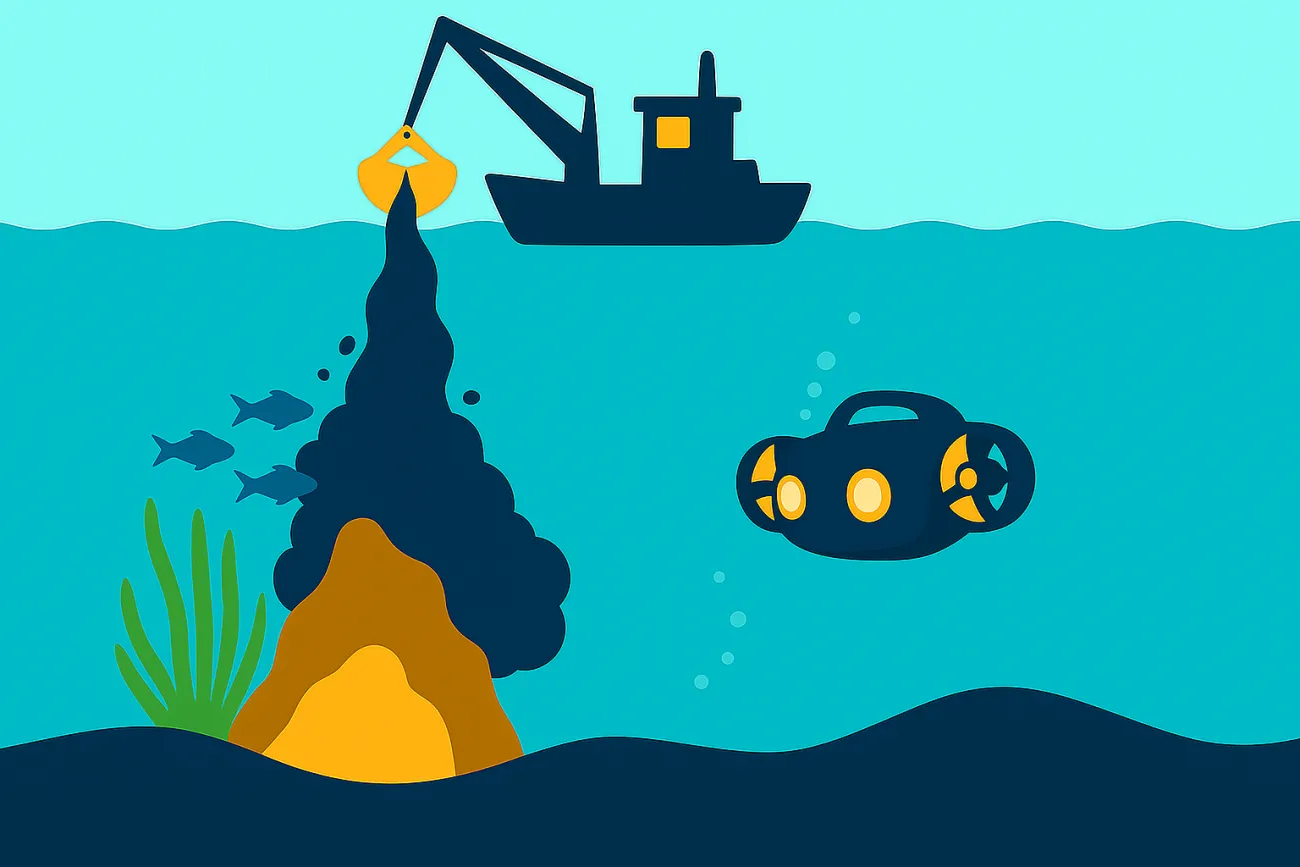
In Luleå, northern Sweden, the Art of the Dredge confronts the ecological and cultural invisibility of large-scale dredging, specifically tied to the Malmporten harbor deepening project. Led by artist-researcher Benjamin Gerdes in collaboration with human ecologist Felicia Fahlin, and political ecologist Henrik Ernstson, the project is hosted by the Institute for Futures Studies (IFFS) and brings local communities into conversation about sediment displacement, industrial reshaping of the coast, and the politics of infrastructure.
Through audiovisual fieldwork, participatory sound mapping, archival re-interpretation, and public workshops, the project creates a space for reflection and critique. Its artistic outputs include:
- A community-built cartography of dredging’s impacts
- Video installations and soundscapes capturing underwater work and disruption
- An annotated digital archive collating generated materials for broader audiences and policymakers.
By working with civic groups, scientists, artists, and maritime stakeholders, the project aims to:
- Increase public understanding of ocean infrastructure and its social and environmental impacts
- Reframe sediment not as waste, but as memory and material witness
- Propose alternative frameworks for inclusive coastal governance.
Expected Impacts:
- Civic Engagement: Citizens gain tools to critique and shape infrastructural decision-making.
- Cultural Memory: Reclamation of narratives often excluded from industrial planning.
- Policy Dialogue: Inclusion of community perspectives in coastal development debates.
- Artistic: Creation of a distinctive body of site-responsive audiovisual work.
- Educational: Resources for schools and museums on marine sediment, coastal ecosystems and political ecologies.
Contact Persons
Benjamin Gerdes <benjamin.gerdes@iffs.se>
Principal Investigator (PI) artistic researcher based at the Institute for Futures Studies (IFFS), Stockholm. He brings expertise in collaborative, interdisciplinary artistic research with an emphasis on documentary video and experimental workshop methodologies.
Felicia Fahlin <felicia.fahlin@iffs.se>
(Co-PI/Lead facilitator) Felicia Fahlin is a human ecologist with experience in artistic research, participatory mapping projects, field recording and documentary production. She works at IFFS with Gerdes.
Henrik Erntsson <ernstson@kth.se>
(Scientific Partner) Henrik Erntsson is a Professor and docent in political ecology at KTH in Stockholm. He currently leads a comparative research project on dredging, Terra Potentia: The World-making Force of Dredging. Focusing on knowledge, infrastructure and the postcolonial condition, he has long experience of using collaborative film-making as part of research.