Meet the Third 8 PAIs Selected by PartArt4OW

After a competitive open call that received 156 applications from across Europe, we’re thrilled to announce the second set of 8 Participatory Art Initiatives (PAIs) selected to join the PartArt4OW accelerator. These initiatives represent bold, creative, and community-driven responses to the challenges facing our seas, rivers, and water basins. Learn more about their unique visions below.

Xarxa Oberta
Oceanographies Collective, Confraria de pescadors de Barcelona, Laboratori d'Ictiologia Genètica (Universitat de Girona)
Barceloneta, Catalan Coast, Western Mediterranean

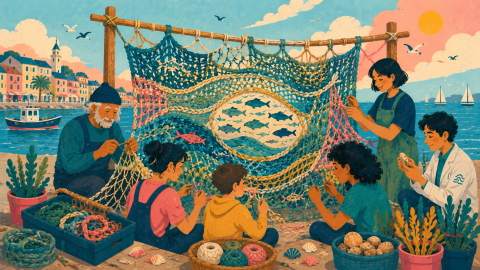
Xarxa Oberta brings into dialogue the ecological vulnerability of sardine populations and the socio-cultural erosion of Barceloneta's fishing community through participatory textile practices inspired by fishing-net repair rooted in a living local blue economy.

Through collaborative workshops combining scientific research on sardine genomics with textile art, fishers' knowledge, and collective memory, the project reconnects the neighborhood with its maritime heritage. Participants transform worn and discarded fishing materials into textile works, making ecological change tangible while valorizing the expertise and life stories of active fishers and strengthening public understanding of the local blue economy.

Sunk Costs
Sunk Costs
The Azores, Portugal (Faial and São Miguel)

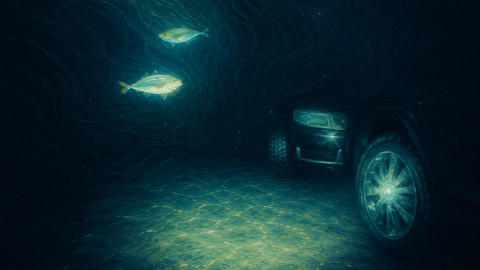
Deep off the Azores, nearly four thousand burnt cars lie at the bottom of the ocean aboard the sunken Felicity Ace. While financial insurance claims closed quickly, the long-term ecological and societal impacts remain unresolved.

Sunk Costs uses this disaster to expose the hidden mechanics of global shipping—including supply chains, liability systems, and the vulnerable island communities caught in these maritime routes. Over six months, this collaborative initiative works with Azorean fishers, maritime experts, scientists, and local residents. Through sound works, maps, shared meals, and community events across the islands, the project explores who truly profits from global trade and who bears its unmeasurable losses, fostering deep reflection on environmental responsibility and coastal life.

REEDable Design
Foundation SANA MARE, Freshwater Solutions, Culture Centre of Ērgļi, Board of Lake Kāla, Pasaules Dabas Fonds (Associated Partner of WWF)
Lake Kāla, Ērgļi, Central Latvia (Baltic Sea catchment area)

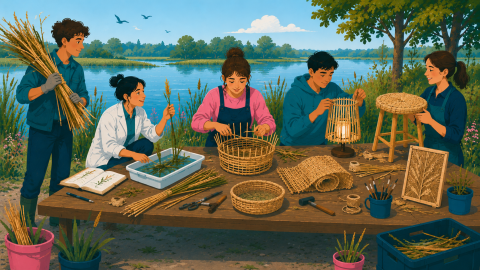
REEDable Design is a participatory art initiative that brings together scenographers, hydrobiologists, and the community of Ērgļi to harvest overgrown reeds from Lake Kāla, co-create functional and aesthetic design objects from this biomass, and make visible the nutrient cycles that connect inland water health with the broader Baltic Sea ecosystem.

Through hands-on reed harvesting, collaborative design workshops, and material experimentation, participants transform a conservation challenge into a creative process. The reeds, which fuel harmful eutrophication when left to accumulate, become beautiful and useful objects—furniture, garden elements, decorative items—that participants design and keep. By demonstrating circular blue economy principles in a rural inland community far from policy centers, REEDable Design makes sustainability tangible and proves that ecological care can be participatory, creative, and profoundly meaningful.
Re-storying Wetlands
RE-PEAT, Ponda biomaterials company
Wetlands of the Netherlands, including North Brabant and Friesland paludiculture sites, Rhine-Meuse delta, Wadden Sea region

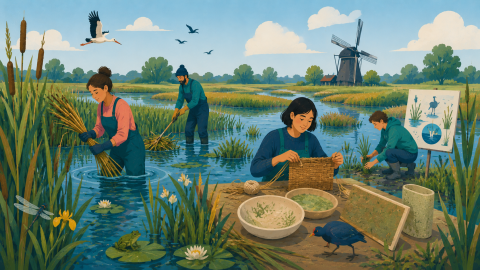
Re-storying Wetlands demonstrates the importance of wetlands for a resilient and equitable blue economy through hands-on paludiculture harvesting, interactive and exploratory biobased material workshops, creative activities, and a youth restoration camp. The project brings together paludiculture farmers, artists, designers, scientists, and community members to explore the material, cultural, and economic potential of wet agriculture.

By combining harvesting demonstrations, artistic experimentation, and creative storytelling, participants discover how restored wetlands can support new forms of economic activity while restoring ecological function. A publication illuminates the potential of wet agriculture and documents the creative and practical insights generated throughout the project.

Plate of Memories
PiNA, Gastronomy High School Izola, Elderly Center Izola, Marine Biology Station Piran
North Adriatic Sea, Izola, Slovenia

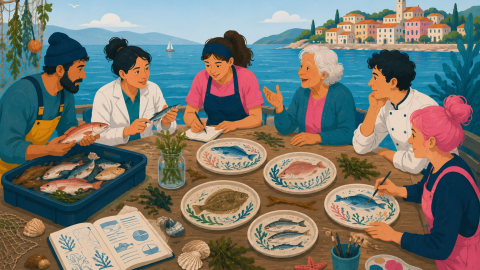
Plate of Memories is a transdisciplinary project that brings together marine scientists, artists, culinary students, fishermen, and elderly residents to reshape the local blue economy toward overlooked fish species. Through participatory field expeditions, collaborative design, and a performative dinner, the project connects scientific data on marine biodiversity with traditional knowledge, innovative cuisine, and artistic storytelling.

Seniors share oral histories of sustainable fishing practices rooted in centuries of maritime tradition. Culinary students learn to transform undervalued species and fish parts into high-end, zero-waste cuisine. Artists with citizens co-design biomaterial serving plates that tell the biological and cultural stories of overlooked fish. The project culminates in a performative dinner where these elements converge, and guests sign the Blue Badge Manifesto, committing to sustainable harvesting and becoming stewards of a circular, community-supported marine ecosystem.

Fading Blue
Albirem
Catalan Mediterranean Coast, Northeastern Spain

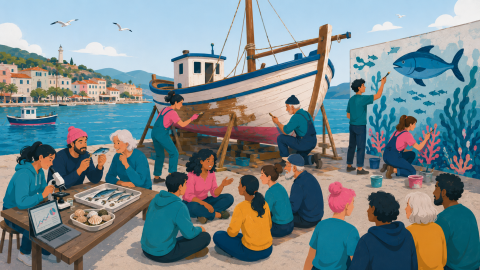
Fading Blue uses the restoration of Odina, a traditional Mediterranean fishing vessel, as a living symbol to explore the decline of blue fish species and artisanal fishing along the Catalan coast. Through participatory art, scientific data analysis, and community engagement, the project links ecological changes in the marine environment to the transformations in fishing communities and maritime cultural heritage.

Citizens, students, fishers, and artists collaborate to restore Odina, create a public mural, and contribute to a documentary that weaves together scientific findings, historical memory, and personal testimony. By highlighting the role of women and LGBTQ+ representation in the fishing sector, and by centering the voices of those often excluded from scientific dialogue, Fading Blue builds awareness of marine biodiversity loss and inspires sustainable relationships with the sea and a regenerative blue economy.

Consulates of the Baltic Sea
Nonhuman Nonsense (lead), The Embassy of the Baltic Sea, Under Ytan
Baltic Sea (Stockholm, Sweden & Åland Islands, Finland)

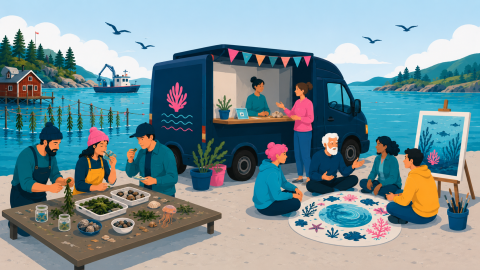
Consulates of the Baltic Sea prototype a participatory governance framework designed to represent the rights and wellbeing of the sea within human economic and political systems. By merging marine science with Rights-of-Nature legal frameworks through "Brackish Diplomacy", a transdisciplinary, learning-by-doing methodology, the project moves beyond awareness into active rehearsal of ecological care.

Through sensory workshops across the Baltic region, citizens, scientists, blue economy actors, and artists co-create a "Mobile Consular Office" and "Sea Ambassador" training program. Using regenerative materials and embodied practices, participants learn to translate the needs of the sea into diplomatic protocols and governance models. The final assembly launches both the prototype and a practical open-source toolkit, enabling other communities to establish their own consulates and become active stewards of the Baltic Sea.

CLAM-EU
University of Montpellier
Sète, Thau Lagoon (Occitanie, Southern France)

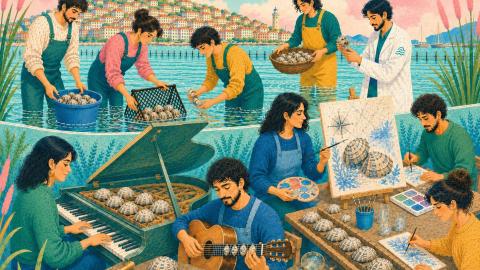
The CLAM-EU project addresses the ecological and economic decline of the European clam in the Thau Lagoon, once a vital resource for Mediterranean fisheries. Using a participatory art-science-community framework, the initiative unites scientists, artists, local citizens, fishermen, students, and regional stakeholders.

Together, they test innovative restoration methods—such as Japan’s "Careshell" experiment—alongside creative workshops featuring prepared-piano music and painting. The project culminates in a public conference, exhibition, and concert at the University Pole Michèle Weil. By transforming scientific data, local knowledge, and community emotions into sensory experiences, CLAM-EU promotes cross-sector dialogue and collective action for lagoon restoration. Ultimately, it supports sustainable blue-economy transitions while establishing a transferable methodology applicable to other European coastal lagoons.