Consulates of the Baltic Sea
Prototyping a participatory governance framework for the rights and wellbeing of the sea
Leading Organisation
Duration
6 months, Phase 3 Accelerator
Location
Baltic Sea, with activities in Stockholm (Sweden) and Åland Islands (Finland)
_______________________________________________
Project Overview
The Baltic Sea faces an acute ecological crisis defined by chronic eutrophication, collapsing fish stocks, and hazardous chemical pollution. This crisis stems from a deep governance gap where administrative structures treat the sea as an inert resource rather than a sentient agent with its own rights and needs. Consulates of the Baltic Sea address this challenge by prototyping a participatory governance framework designed to represent the rights and wellbeing of the sea within human economic and political systems.
The project integrates five essential perspectives: scientific understanding of the Baltic crisis, legal inquiry into Rights-of-Nature as a governance pathway, embodied sensorial experience through hands-on work with water, cultural connections rooted in regional identities, and moral-philosophical reflection on human interdependencies with the more-than-human world. The result is a practical toolkit and training program that enables communities across the Baltic to establish their own consulates and transform from passive "users" into active, empathetic stewards of the sea.
Scientific Foundation & Research Questions
At the core of Consulates are three guiding questions: How to speak for the Baltic Sea? What distinguishes harm from care in the blue economy? And how can citizens develop long-term responsibility for the sea? The project approaches these through marine systems thinking (eutrophication, benthic health) combined with Rights-of-Nature legal frameworks.
Scientists from the Embassy of the Baltic Sea create the scientific basis for all co-creation workshops, ensuring exercises are grounded in ecological understanding of the sea as a living entity. The innovation lies in translating marine science into sensory, emotional, and embodied engagement, making visible the invisible processes of ecosystem interdependence. Through this transdisciplinary toolkit integrating qualitative embodied experience with quantitative marine science, the project advances the state-of-the-art in art as a socio-ecological practice.
Methodology: "Brackish Diplomacy"
"Brackish Diplomacy" is a learning-by-doing methodology that translates marine science and Rights-of-Nature legal frameworks into embodied artistic and social practice. Rather than presenting pre-determined outcomes, participatory workshops function as "laboratories of care" where citizens, scientists, and economic actors collaboratively build a curriculum for "Sea Ambassadors".
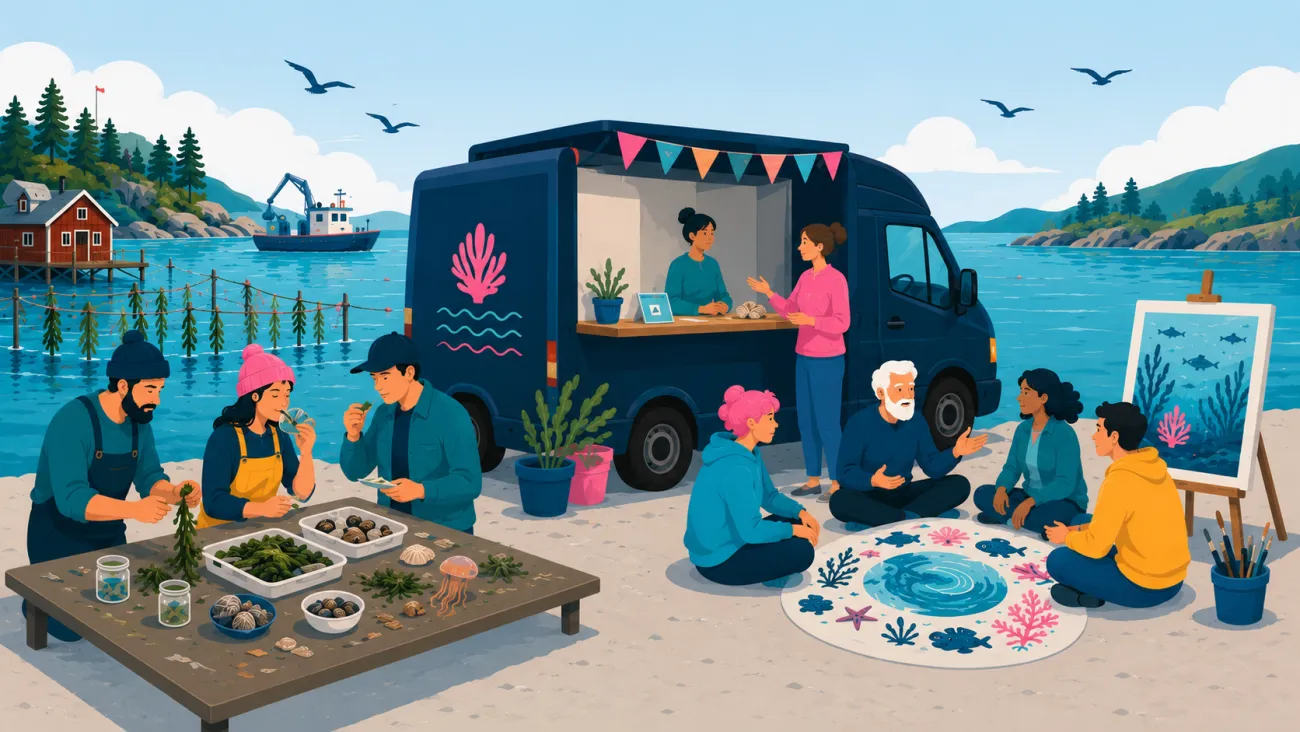
Through sensory experiments, creative exercises, and roleplaying, participants learn to articulate the needs of species and ecosystems they represent. Using Under Ytan's regenerative materials, such as tasting seaweed, touching seagrass, or engaging in tactile exploration of restored habitats, the project translates scientific mechanisms of interdependence into deep relational literacy. Each workshop's outputs shape the next in an iterative, community-led design process, ensuring that the emerging Mobile Consular Office and Sea Ambassador training modules reflect the voices and knowledge of those most connected to the Baltic.
Community Engagement & Rights
Citizens, scientists, blue economy actors, and artists participate as co-researchers and co-creators throughout the project. Participants include sustainability practitioners from Omställningskonferensen, small-scale fishers from Åland whose tacit knowledge is typically excluded from elite science, and the general public engaged through cultural venues.
By inviting small-scale fishers, participants from diverse socioeconomic backgrounds, and others far from traditional science and art institutions, Consulates build solidarity with those traditionally overlooked in policy discussions. A sensory, playful approach lowers barriers to participation, replacing technical jargon with embodied activities.
Ocean Literacy & Long-Term Impact
The project builds a deep, sensory, and ecological understanding of the Baltic Sea, moving participants beyond passive awareness into active advocacy. By treating the Baltic as a living, interdependent system, the project embeds systemic responsibility and relational literacy into each participant's experience.
- Short-term (6 months): Development and testing of the Consulate framework and prototypes. Participants experience a shift from passive awareness to active stewardship, with increased relational literacy and sensory connection forged through co-creation.
- Medium-term (1 year): The Consulate framework and toolkit enable the Embassy of the Baltic Sea and blue economy actors to model regenerative governance and ecosystem representation. Pop-up consulates and additional PAIs are activated through the project's partner network.
- Long-term (5+ years): The project contributes to systemic shifts toward ecosystem stewardship and Rights-of-Nature governance models. The framework is developed, adapted, and implemented in other coastal regions, providing tools to bridge the gap between scientific thresholds and community-led action.
Expected Outcomes
Main output: Development and publication of an open-access Baltic Sea Consulate Framework based on co-created and tested participatory methodologies. This includes a practical toolkit with principles and relationships for establishing consulates, a code of conduct identifying extractive and regenerative practices, and a "Sea Ambassador" training program.
Additionally: A visual identity and campaign webpage outlining how future consulates can be established; presentations and documentation; social media updates; formation of new networks between ecological, economic, and artistic actors across the Baltic Sea region.
All outputs will be published following Open Science principles: methodological frameworks, workshop designs, and non-sensitive documentation available online with scientific sources referenced. The Consular Toolkit will be open source and designed for adaptation by other Baltic communities, institutions, and networks.
Key Team & Partners
Project Leadership & Core Team:
- Nonhuman Nonsense – A research-driven art and design collective working in the realm of social dreaming and world-making. Their projects engage with the nonhuman: animals, objects, ecology, technology, and the spectres between and beyond categories.
- The Embassy of the Baltic Sea (EBS) – Working for interconnected wellbeing of human society and nature in the Baltic Sea watershed, through recognition of the rights of the sea to flourish, and representation of its more-than-human voices in decision-making.
- Under Ytan AB – Finnish/Åland-based regenerative business specializing in sustainable marine product development, habitat restoration systems, seaweed farms, and aquaculture.
Sustainability & Long-Term Vision
The project's legacy extends beyond the six-month accelerator. The open-access Baltic Sea Consulate Framework, practical toolkit, training modules, and methods enable other communities to establish pop-up consulates and act as ambassadors for the sea. The toolkit will be used and continuously developed by the Embassy of the Baltic Sea and will remain publicly available for reuse by communities, cultural organizations, and blue economy actors.
Future phases will seek support from regional cultural funds, EU cooperation programmes, and partnerships with municipalities and marine research institutions to expand the network of consulates across the Baltic Sea region and eventually to other coastal areas.
Resources & Further Information
Key Partner Websites:
- Nonhuman Nonsense: https://nonhuman-nonsense.com/
- The Embassy of the Baltic Sea: https://www.embassyofthebaltic.se/
- Under Ytan: https://www.underytan.com/
- Omställningskonferensen: https://omstallningskonferensen.se/
- Transit Kulturinkubator: https://transitkulturinkubator.se/