Re-storying Wetlands
Exploring the material, cultural, and economic potential of paludiculture and wet agriculture for sustainable blue economies
Leading Organisation
RE-PEAT
Duration
6 months, Phase 3 Accelerator
Location
Wetlands of the Netherlands, specifically paludiculture sites in North Brabant and Friesland.
_______________________________________________
Project Overview
Wetlands are amongst the most carbon-rich ecosystems on Earth. Yet across Europe, the majority have been drained, leading to significant emissions, land subsidence, biodiversity loss, and long-term water management challenges. Current agricultural systems are economically dependent on drainage, creating a difficult transition for farmers and locking in extractive land use systems. Paludiculture, wet agriculture, offers a promising alternative, enabling agricultural production on wet soils while restoring ecological functions of wetlands.
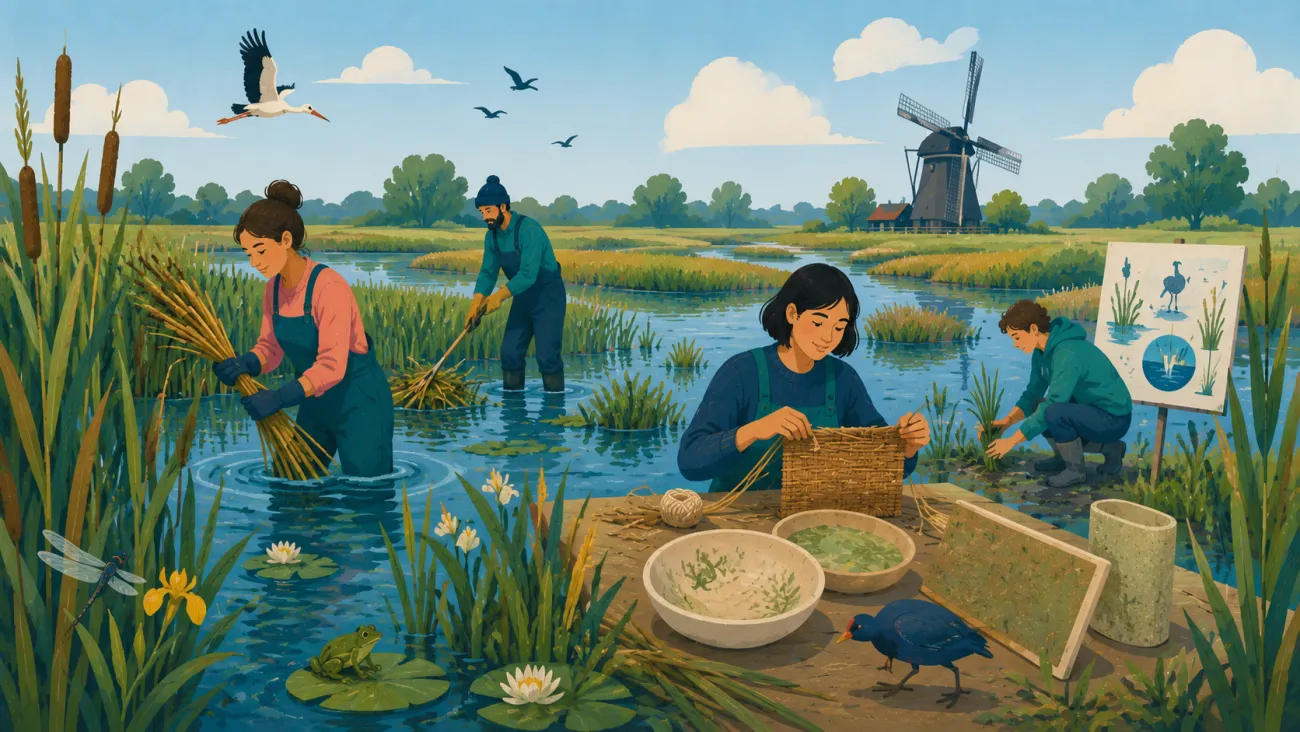
Re-storying Wetlands addresses the cultural, material, and economic dimensions of wetland-based economies that remain under-examined. The project brings together paludiculture farmers, artists, designers, scientists, and community members in meaningful and action-oriented spaces to engage directly with paludiculture practices and materials. Through hands-on harvesting demonstrations, interactive biomaterial workshops, creative activities, a youth restoration camp, and a publication on wet agriculture, the project demonstrates how ecological restoration can be translated into tangible materials, products, and stories that reshape cultural narratives around wetlands.
Scientific Foundation
There is an extensive and growing body of research on wetland restoration and paludiculture as climate mitigation strategies. Re-storying Wetlands draws on this research to ask: How can paludiculture sites be understood not only as ecological restoration sites but also as cultural, material, and economic infrastructures within emerging blue economies? While scientific research has extensively examined the climate and ecological benefits of peatland restoration, less attention has been given to the cultural, material, and experiential dimensions of wetland-based economies.
The project will draw from an existing network of collaborators, including scientists, researchers, and conservationists attending the Power to the Peatlands conference who are at the forefront of paludiculture research and implementation, to ensure scientifically sound activities. The research question guiding the initiative is: How can artistic practice, design, and cultural imagination help communities envision new relationships between society, wetlands, and economic activity? By positioning artists and citizens as active participants in paludiculture research and practice, the project advances the state of the art by integrating ecological restoration with creative expression.
Art-Science Methodology
Re-storying Wetlands embeds artistic practice directly within the emerging field of paludiculture, positioning artists and citizens as active participants. Participants engage with the full lifecycle of wetland biomass, from landscape management and harvesting through design, communication, and dissemination. This approach brings together actors who rarely collaborate directly: farmers, product designers, material researchers, and artists.
The project demonstrates how creative sectors can help translate ecological transitions into tangible materials, products, and stories. Activities include the harvesting wet futures event (manual and mechanical harvesting, open harvest demo, and hands-on workshops in art, design, and biomaterials); documentation and publication of findings; presentations at the Power to Peatlands conference connecting to international networks; artistic development and stakeholder dialogues; a paludi-dinner bringing together stakeholders for continued dialogue; the re-storying wetlands camp for youth combining restoration activities and art workshops; and a final publication and digital archive launching insights and outputs to wider audiences.
Community Engagement & Participation
The project engages paludiculture farmers, artists and designers in environmental and creative fields, interested citizens, and youth. Farmers share practical knowledge and participate in workshops contributing creative works. Artists, designers, and students will lead and participate in workshops and contribute creative works. Citizens will engage through public events and the paludi-dinner. Youth will participate in the restoration camp and develop artistic responses.
Engagement is encouraged through open calls, collaboration with community-led spaces, outreach through partner networks, and open public events. The project will engage underrepresented groups through targeted promotion of open, collaborative spaces and free or low-cost workshops. Youth microgrants support participants who may not otherwise access creative grants. Combining varied hands-on activities with accessible experimentation, the project seeks to engage individuals who may feel distant from science and/or art. All workshops will have gender balance and the project will actively promote participation by women and gender-diverse individuals.
Water Literacy & Ecosystem Connections
The project highlights the critical but often under-recognized connections between inland wetlands, river systems, and marine environments. Wetlands are key components of global water cycles: they regulate water flows, store carbon, filter pollutants, and influence the quality and quantity of water that ultimately reaches rivers, estuaries, and seas. Despite these strong ecological links, the role of inland wetlands in supporting ocean health is often overlooked within public discussions of marine conservation and the blue economy.
Re-storying Wetlands foregrounds this lesser-known aspect of the blue economy and takes a holistic approach to deepen understanding and action on water systems. By connecting participants directly to wetland restoration and paludiculture practices, the project builds visceral, embodied connections to these ecosystems and demonstrates how inland water management is essential to ocean health.
Expected Impacts
- Short-term (6 months): Participants gain knowledge, networks, and creative tools to engage with wetlands and paludiculture. Citizens and youth build stronger connections to wetlands through hands-on activities, artistic experimentation, and restoration participation. Farmers share knowledge and connect with designers and researchers exploring new uses for wetland biomass. Policymakers gain insight into how paludiculture can scale as a sustainable wetland economy. Creative outputs help shift public narratives around wetlands.
- Medium-term (1 year): The publication and digital archive provide accessible resources for future practitioners working with wetlands, biomaterials, and restoration. Networks between cultural practitioners, farmers, and environmental organisations strengthen, supporting new collaborations. Relationships established between participants continue through further initiatives around paludiculture and wetland economies.
- Long-term (5+ years): Wetlands gain stronger cultural and economic recognition as productive landscapes supporting restoration, sustainable materials, and water-based livelihoods. Creative and scientific collaboration becomes more established in wetland restoration and paludiculture development.
Expected Outputs
- Artistic & Material: 20–30 artistic and material works using wetland biomass. Records of harvesting and creative processes. Creative responses from youth participants.
- Publications & Documentation: Wet Futures publication (150–200 copies plus digital version) documenting the project, harvesting, and creative processes. Blog posts and social media content. Digital archive accessible through the RE-PEAT website. Presentations at conferences.
- Community & Engagement: Re-storying Wetlands Gathering presenting insights and outputs to wider audiences. Strengthened networks between farmers, artists, designers, researchers, and environmental organisations.
Key Team & Partners
Project Leadership:
RE-PEAT – Youth-led collective with over 5 years of experience organizing events and designing communications related to peatlands. Core members include Frankie Turk (Network & Restoration Academy Coordinator) and Holly Bartley (Programme & Development Officer). Both bring extensive experience through the Restoration Academy EU project (2023–2026), organizing youth nature restoration camps and developing educational materials.
Bethany Copsey – Creative Producer contributing to artistic output and publication design. Will coordinate creative engagement and help facilitate hands-on workshops.
Consortium & Collaborating Partners:
- Ponda – Biomaterials company developing textiles from crops such as cattail, working with paludiculture farmers in the Netherlands, UK, Germany, and Canada. Ponda contributes expertise on wetland plants and their applications in bio-based industries. They participate in harvests and workshops as a blue economy actor, sharing practical insights and communication expertise.
- Paludiculture farmers – Farmers in North Brabant and Friesland provide access to their lands and share practical knowledge of paludiculture operations. They participate in workshops and contribute to creative development.
- Biosintrum - Knowledge and conference centre consisting of more than 80% biobased materials and a meeting place for education, entrepreneurs, and government.
Sustainability & Continuation
Project activities align with ecological restoration and low-impact event organisation. Measures include prioritising local and low-carbon travel, using natural and biodegradable materials for workshops and experimentation, and using and creating with invasive plants as a temporary measure. Producing the publication on paludiculture-based paper sourcing sustainable food and supporting locally sourced sustainable practices.
Work and outcomes will continue well beyond the six-month accelerator through the publication and digital archive, which will remain publicly accessible and empower participants to initiate future projects on wetlands, restoration, and sustainable materials. Relationships built between farmers, artists, designers, and researchers will continue through further initiatives around paludiculture and wetland economies, linking up with existing networks. Following the project, the team will pursue additional funding to continue and expand this work, particularly restoration camps and creative engagement with paludiculture and wetland economies.
Inclusivity & Diversity
RE-PEAT is youth-led and includes members from diverse backgrounds. The project will follow relevant guidelines and work to engage underrepresented groups through targeted outreach and microgrants offering creative grants. The project brings together groups that rarely interact (farmers, artists, policymakers, researchers) to collaborate and shape outcomes. Diversity will be encouraged through targeted outreach and through offering creative opportunities, particularly to youth and underrepresented groups.
Resources & Further Information
Key Partner Organizations:
- RE-PEAT (Youth-led collective working on peatlands and restoration): https://www.re-peat.earth/
- Ponda (Biomaterials company developing bio-based textiles from wetland crops): https://www.ponda.eco/
- Power to the Peatlands Conference (Event connecting science, policy, and practice through lectures, interactive workshops, and field visits): https://power2peatlands2026.com/ (or the current conference information page: https://sites.google.com/view/power2peatlands2026/home)
- Paludiculture Farmer Network (Working across North Brabant and Friesland): https://www.paludiculture.eu/